Overview
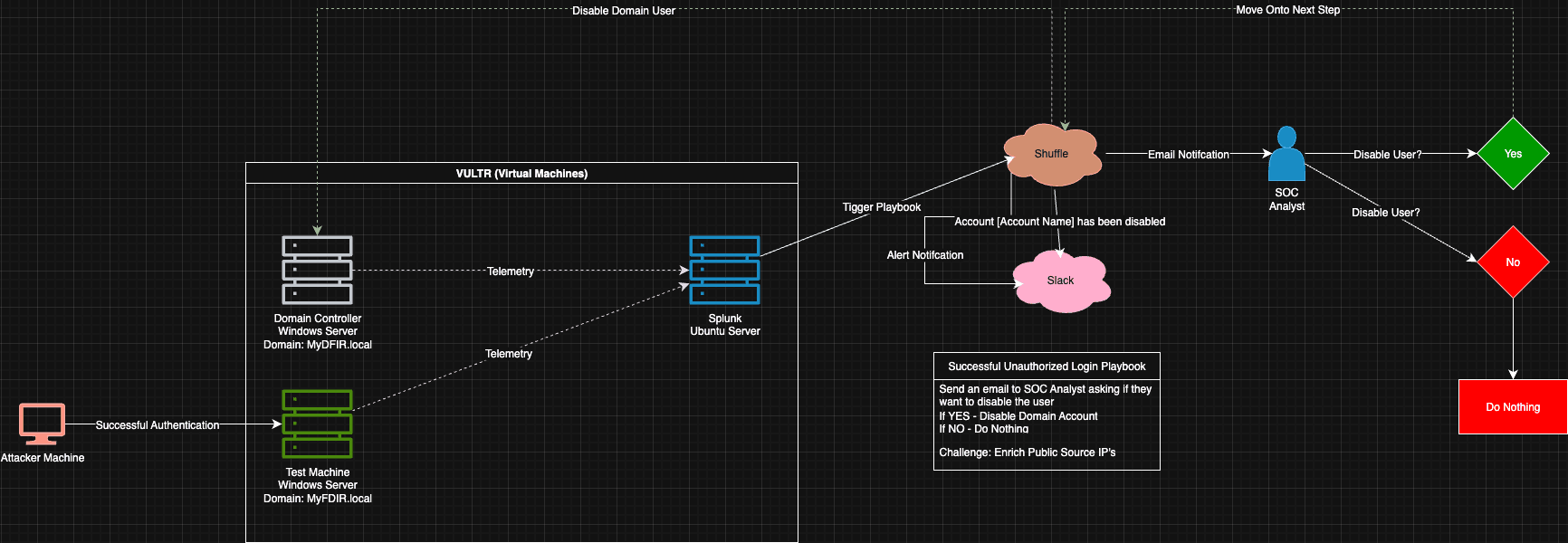
- Detect unauthorized successful Windows logons in Splunk (Event ID 4624, LogonType 7/10).
- Notify in Slack with user, host, source IP, and time.
- Approve via Shuffle User Input email (Yes/No).
- Contain automatically in Active Directory: disable the user via LDAP.
- Confirm in Slack and verify in ADUC.
Key Features
-
Cloud lab topology (VPC):
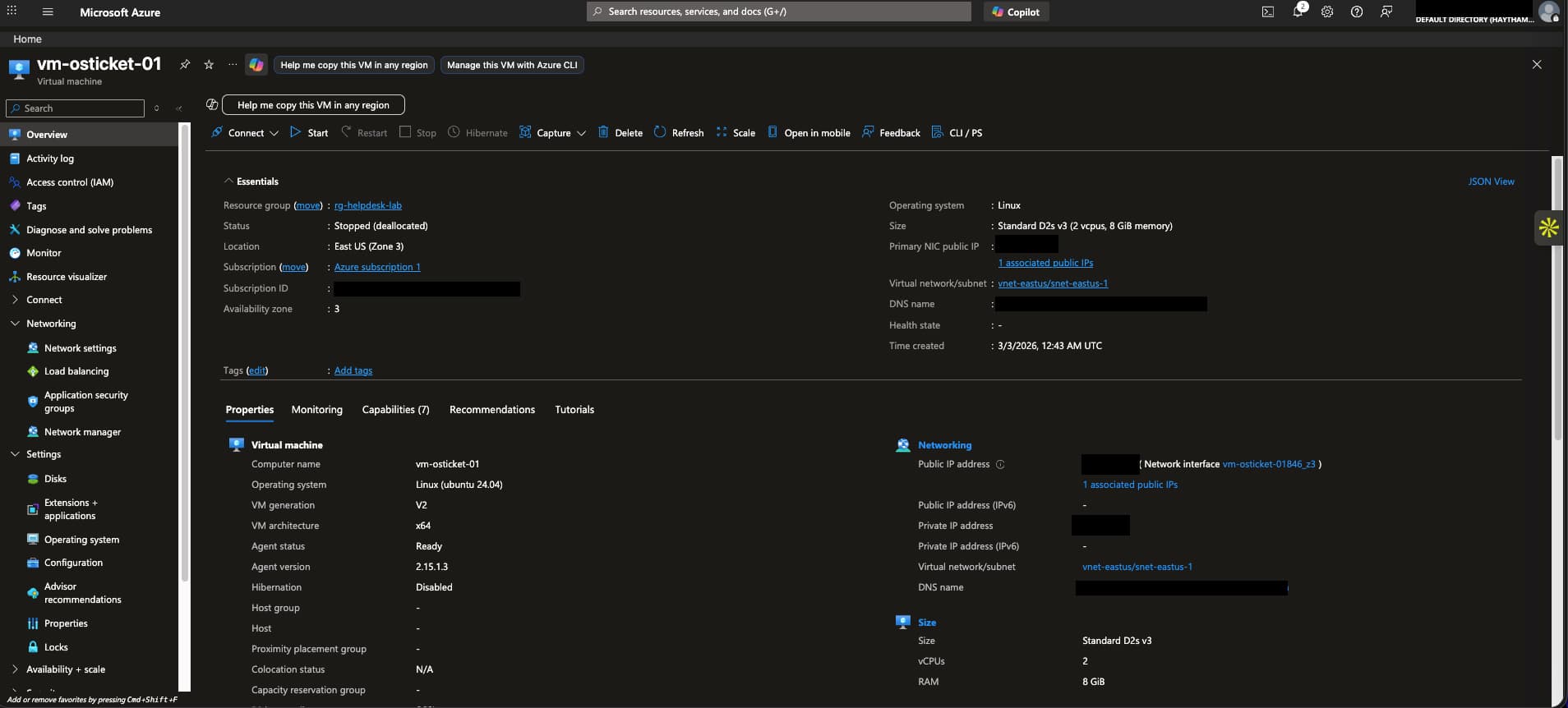
- Windows Server 2025 Domain Controller (AD DS), Windows Server 2025 Test VM, and Ubuntu 22.04 Splunk server on isolated VPC.
- Host & cloud firewalls tuned for 3389 (RDP), 8000 (Splunk Web), and 9997 (Splunk receiving).
-
Active Directory setup:
- Promoted DC; domain MyDFIR.local.
- Created Jenny Smith (JSmith) test user; enabled RDP access on the Test VM for domain users.
- Verified domain joins and sign-in behavior (MYDFIR\JSmith vs local account context).
-
Splunk ingestion & detection:
- Installed Splunk Enterprise on Ubuntu; set TZ to GMT; added Splunk Add-on for Microsoft Windows.
- Created index mydfir-ad; enabled receiving on :9997.
- Deployed Universal Forwarder on both Windows hosts; added:
Conf
# inputs.conf (local) [WinEventLog://Security] index = mydfir-ad disabled = 0 - SPL detection for successful RDP logons (offsite):
Spl
index=mydfir-ad EventCode=4624 (Logon_Type=7 OR Logon_Type=10) Source_Network_Address=* Source_Network_Address!="-" | eval human_time=strftime(_time,"%Y-%m-%d %H:%M:%S %Z") | stats count by _time, human_time, ComputerName, Source_Network_Address, user, Logon_Type - Saved as scheduled alert “MyDFIR-Unauthorized-Successful-Login-RDP” (ran every minute during testing).
-
Slack alerting:
- Slack workspace + #alerts channel.
- Message template (from Shuffle) with runtime args:
Alert: $exec.search_name Time: $exec.result.human_time User: $exec.result.user Source IP: $exec.result.Source_Network_Address - Used channel ID to route reliably to #alerts.
-
Shuffle SOAR workflow (human-in-the-loop):
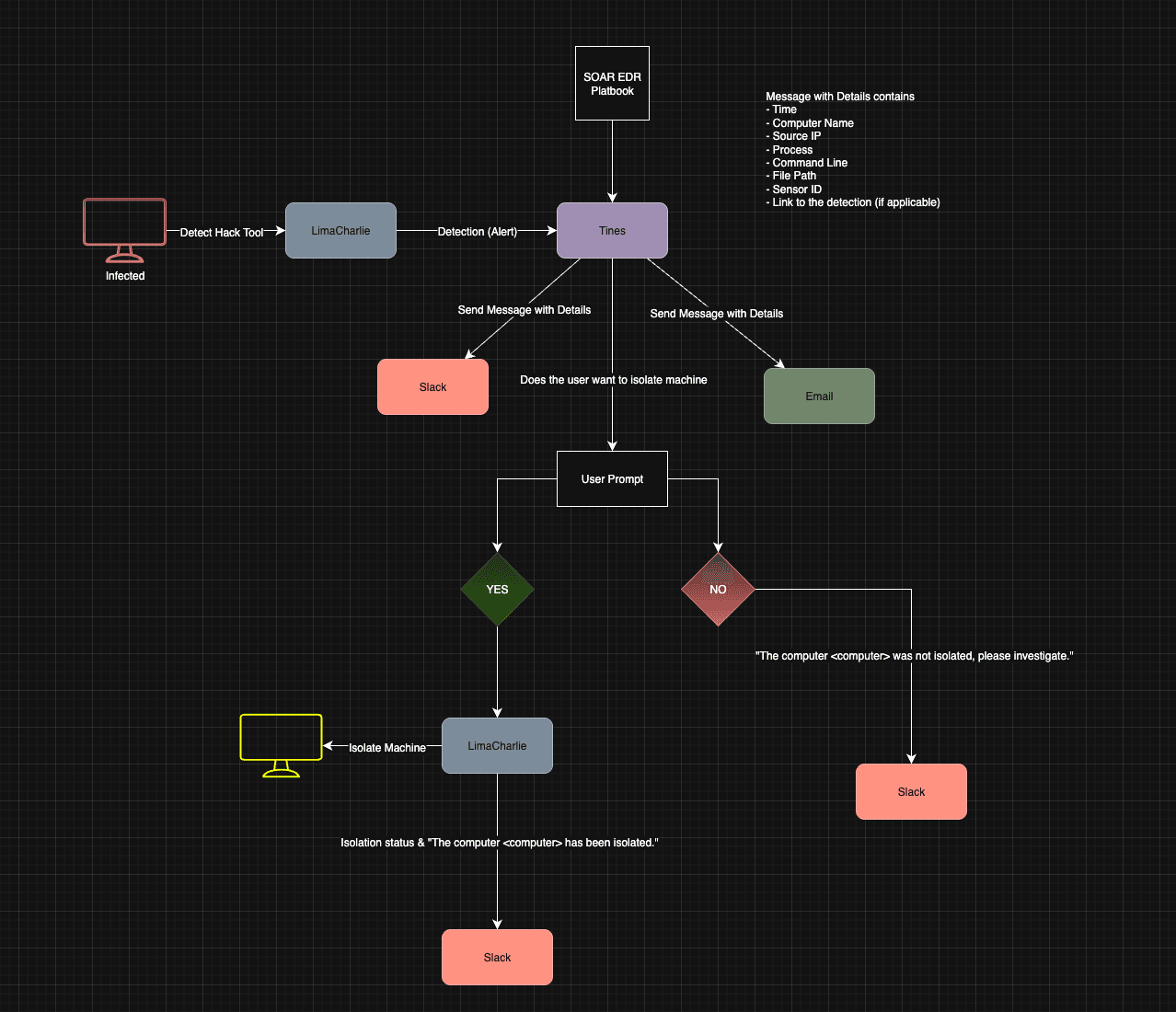
- Webhook (from Splunk) → Slack alert → User Input (Email Yes/No) → Active Directory: Disable User → Get User Attributes → Condition → Slack confirmation.
- LDAP details: host (DC), port 389, useSSL=false (testing), Base DN CN=Users,DC=MyDFIR,DC=local.
- Account mapping: normalized $exec.result.user to sAMAccountName (e.g., JSmith) to avoid domain prefix issues (MYDFIR\JSmith).
- Post-action verification: parsed user attributes and matched userAccountControl state (or attribute blob contains ACCOUNTDISABLE) before sending Slack success message.
-
Proof of remediation:
- Final Slack message: “Account JSmith has been disabled.”
- ADUC screenshot shows the down-arrow on the user icon and “Enable account” in the context menu.
Technologies Used
- Windows & AD: Windows Server 2022, AD DS, ADUC, LDAP (389).
- Linux & SIEM: Ubuntu 22.04, Splunk Enterprise, Splunk Add-on for Microsoft Windows, Universal Forwarder.
- SOAR & Messaging: Shuffle (webhooks, user input, app actions), Slack API (chat.postMessage).
- Networking & Security: VPC networking, RDP (3389), UFW rules, role-based access (email approvals), least-privilege after testing.
- Detection Engineering: Windows Event IDs (4624), Logon Types (7/10), SPL authoring, alert scheduling, runtime arg templating.
- Evidence & Ops: Run logs, Explore Runs, Slack channel IDs, sanitized screenshots.
Challenges and Learnings
- OAuth & Slack scopes: Resolved invalid_scope and not_in_channel by using correct chat:write scope and posting via channel ID with the bot invited to #alerts.
- Webhook vs “Play” runs (Shuffle): To pass runtime args ($exec.*), I triggered from the Webhook start node; manual Play runs skip nodes or lack payloads.
- LDAP bind & policy errors: Encountered strongerAuthRequired; for testing, used 389 / no SSL and a temporary privileged test account to validate binding (then reverted).
- Username normalization: $exec.result.user sometimes arrives as MYDFIR\JSmith. Mapping to sAMAccountName=JSmith fixed “No user found” errors.
- Sequencing & conditions: Ensured the Slack confirmation only fires after attributes show the disabled state (checked userAccountControl/attribute text).
- Security hygiene: Opened RDP and Splunk ports narrowly; widened briefly for test signal; locked down after validation. Sanitized public IPs, channel IDs, webhook IDs, emails in screenshots.
Outcome
- Operational flow: Unauthorized successful RDP logins are detected within a minute, surfaced to Slack with context, approved by email, and contained by disabling the AD user—then verified and announced.
- SOC value: Converts a noisy identity tactic into a repeatable, governed playbook, improving MTTD/MTTR and reducing reliance on ad-hoc manual steps.
- Next steps:
- Add IP reputation enrichment pre-approval to aid triage.
- Implement LDAPS (636) with certs and a service account scoped for disable-only.
- Extend to re-enable flow with ticket linkage and post-incident checks (MFA, password reset, device health).