

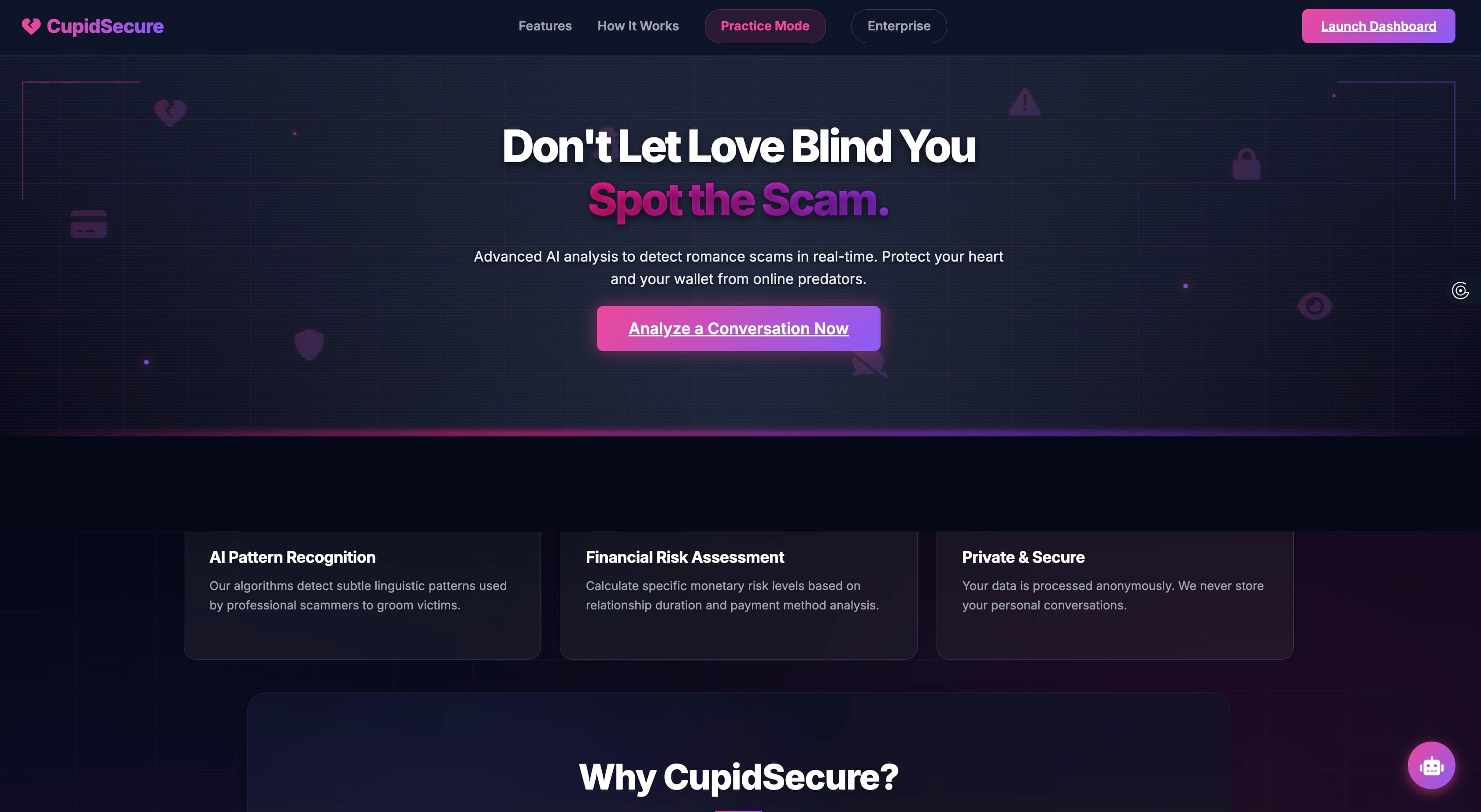
Overview
Romance scams cause over a billion dollars in reported losses every year, and many victims never come forward because of shame. CupidSecure is designed as a quiet, trusted AI copilot that helps people sanity-check conversations and understand red flags without needing to talk to anyone first.
Key Features
Conversation Analyzer (Text + Screenshots)
- Users can paste conversations or upload screenshots from dating and messaging apps.
- A Gemini-powered analysis pipeline detects romance-scam tactics such as:
- Love bombing and rapid escalation of intimacy.
- Overseas deployment or remote work stories.
- Crisis and emergency money requests.
- Crypto, gift card, or wire transfer asks.
- The system returns:
- A 0–100 risk score with color-coded severity.
- A red flag timeline / heatmap showing how risk increases across the conversation.
- A list of detected tactics with short explanations written for non-technical users.
Financial Request Check
- Dedicated module for when money comes up in a conversation.
- Inputs:
- Amount requested.
- Payment method (e.g., bank transfer, gift cards, crypto).
- Relationship duration (days/weeks).
- Stated reason for the request.
- Combines these into a financial risk score with justification, flagging especially risky patterns like:
- Large amounts early in the relationship.
- High-risk payment methods.
- Classic emergency narratives.
- Output is a simple recommendation like “High risk – do not send” plus a brief rationale.
Practice Mode – Scammer Simulator
- Interactive Scammer Simulator where the AI plays various romance-scam personas:
- Deployed soldier overseas.
- Long-distance professional with sudden crisis.
- “Investor” with guaranteed returns.
- Users chat with the AI as if it were a real person and try to spot red flags in real time.
- After a set number of messages, the simulator:
- Reveals the tactics it used.
- Highlights missed warning signs.
- Suggests better responses for next time.
- Designed for workshops, campus events, or self-guided training.
Risk Dashboard
- An enterprise-style dashboard surfaces high-level metrics, including:
- Active monitored users.
- Risky conversations flagged in the last 7 days.
- Estimated loss prevented.
- Average risk score across the system.
- Visualizations:
- Weekly threat trend line.
- Scam type distribution (donut chart).
- Geographic hotspots inside the US.
- Intended for future integrations with:
- Dating platforms.
- Counselors or victim-support organizations.
- Campus safety offices.
Embedded AI Assistant
- A persistent Cupid AI assistant appears across pages via a chat bubble.
- Explains:
- What each section does.
- How to interpret risk scores and red flags.
- What actions to take if a conversation looks unsafe.
- The goal is to make the product approachable for users who are anxious, non-technical, or unfamiliar with security tools.
Technologies Used
-
Frontend
- TypeScript.
- React-style single-page application.
- HTML/CSS with a dark, security-inspired design system.
- Componentized sections: Hero, Why CupidSecure, Mission, Analyzer, Practice Mode, Dashboard, FAQ, Team.
-
Backend & AI
- Node.js / Express-style API layer.
- Gemini 2.0 Flash for:
- Conversation and screenshot analysis.
- Scam tactic classification.
- Risk scoring and natural-language explanations.
- Simulator persona dialogues and coaching messages.
- Custom financial-risk heuristics (amount, duration, payment method, reason).
-
Other
- GitHub for version control.
- Vercel for deployment and CI.
- GoDaddy domain management for cupidsecure.com.
Design & UX
-
Theme:
- Dark, cyber-security inspired aesthetic with magenta/purple accents to match the “Cupid” brand.
- Subtle grid background and glow borders to create a security dashboard feel without overwhelming the user.
-
UX priorities:
- Clear information hierarchy:
- Hero → Features → Analyzer → Practice → Dashboard → Mission → FAQ → Team.
- Simple, high-contrast CTAs such as “Analyze a Conversation Now”.
- Readable risk summaries and action lists rather than dense paragraphs.
- Privacy-first messaging (in-memory analysis, no long-term storage) surfaced prominently.
- Clear information hierarchy:
-
Micro-interactions:
- Hover states on navigation, cards, and buttons.
- Smooth scroll between sections.
- Light elevation animations on cards to reinforce clickability.
Challenges & Learnings
-
Designing for shame and fear:
Many users are embarrassed to talk about potential scams. We had to design flows that feel private, non-judgmental, and safe to try in under a minute. -
Explainability over raw scores:
A single 0–100 number isn’t enough. It took iteration to combine:- A simple risk bar.
- A red flag timeline.
- Named tactics and recommended actions. into a layout that people can scan quickly.
-
Realistic but safe simulation:
Building the Scammer Simulator required balancing realism with safety—capturing common scam narratives without veering into exploitative or overly graphic content. -
Timeboxing an end-to-end product:
Within a hackathon weekend, we had to scope aggressively:- Focus on a clean, cohesive MVP.
- Reuse components across pages.
- Keep the backend thin and delegate as much as possible to the LLM.
Outcome
-
Hackathon recognition:
- Awarded 1st Place in the Blockchain, Cyber & Security track at HackFax × PatriotHacks 2026.
-
Working live demo:
- Deployed to https://cupidsecure.com with:
- Functional analyzer.
- Scammer Simulator.
- Financial Request Check.
- Risk dashboard.
- AI assistant and marketing site.
- Deployed to https://cupidsecure.com with:
-
Future directions:
- Direct integrations with dating platforms and messaging apps.
- Mobile app with one-tap screenshot upload.
- Evidence packaging for IC3 and law-enforcement reports.
- Partnerships with universities, banks, and nonprofits for awareness training.